How to Choose the Best AC to AC Inverter for Your Needs?
Choosing the right AC to AC inverter can significantly impact your energy efficiency. With various models available, understanding your requirements is crucial. An inverter converts alternating current (AC) from one voltage level to another. It is essential for applications like solar energy systems and electrical appliances.
When selecting an AC to AC inverter, consider the specific needs of your devices. Think about power ratings and compatibility with your existing systems. A mismatch can lead to inefficiencies. You may find that certain inverters perform better under specific conditions. User reviews often highlight real-world experiences, which can guide your decision-making process.
While one might assume that higher capacity equals better performance, this is not always true. Sometimes, a lower-rated inverter suits your needs perfectly. Each scenario requires careful evaluation. Pay attention to reliability and brand reputation, as these factors significantly influence long-term satisfaction. In this guide, we will explore important considerations to help you make an informed choice.

Factors to Consider When Selecting AC to AC Inverters for Specific Applications
When selecting an AC to AC inverter, consider the specific application. Different projects have unique demands. Do you need high efficiency? Look for inverters that optimize energy use. For industrial applications, robust units handle heavy loads better.
Size is another crucial factor. A small inverter may not deliver the required power. Conversely, an oversized model wastes energy and raises costs. Evaluate the space where the inverter will be installed. Compact models fit small areas but may compromise on power output.
Finally, think about features that matter for your situation. User-friendly interfaces enhance operation for beginners. Advanced monitoring can assist experts in troubleshooting. Not all models offer this flexibility. Reflect on your long-term needs to choose wisely.
Balancing capacity, size, and features ensures the inverter will serve effectively.
Understanding Different Types of AC to AC Inverters: A Comparative Overview
When choosing an AC to AC inverter, it is essential to understand the different types available. Each type serves unique purposes and has distinct features. Common types include standalone inverters, grid-tied inverters, and hybrid inverters. Standalone inverters are ideal for remote areas where grid access is limited. Grid-tied inverters work well for those who benefit from the existing power grid. Hybrid inverters combine both approaches, offering flexibility.
Tips for selecting an inverter include assessing your power needs. Calculate your total wattage consumption to determine the inverter's capacity. Remember that higher capacity typically means higher costs. Factor in where you plan to use the inverter. This will influence performance and efficiency. Additionally, consider the inverter’s efficiency rating. A higher rating often indicates better performance, but at times, cheaper options might suffice, depending on your use case.
Choosing an inverter can be overwhelming. Many forget to consider noise levels. Some inverters operate quietly, while others can be quite loud. This might affect your living environment. Ultimately, ensure that your choice aligns with your specific needs and preferences. Reflection on your priorities can lead to better decisions.
Assessing Input and Output Specifications for Optimal Performance
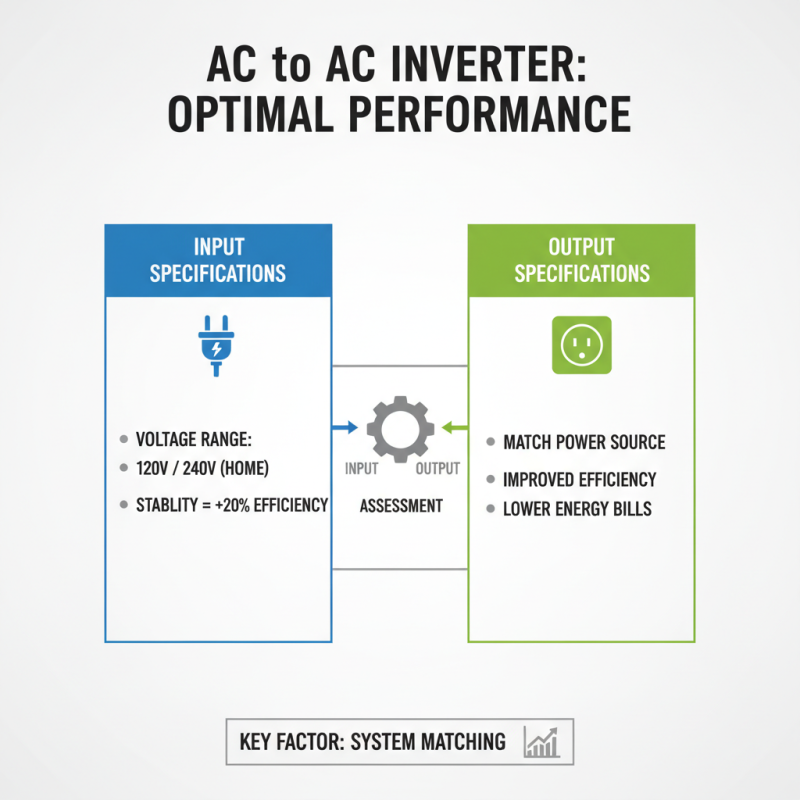
When selecting an AC to AC inverter, understanding input and output specifications is crucial. Input voltage ranges significantly affect usage scenarios. For home systems, common input voltages are 120V or 240V. Comparing these specifications helps ensure the inverter matches your power source. Industry studies show that systems with stable input voltages improve efficiency by up to 20%. This efficiency translates to lower energy bills and enhanced performance.
Output specifications also play a key role. The output voltage should match your equipment’s requirements. For instance, a standard output might be 120V, but if your devices demand higher voltages, mismatches can occur. Performance analysis reveals that inverters delivering consistent output within ±5% of the rated value are optimal. This precision minimizes equipment stress and prolongs lifespan. It's important to check the total harmonic distortion (THD) too; ideally, look for figures below 5% for sensitive electronics.
Installation environment affects the inverter’s performance as well. Temperature, humidity, and airflow around the unit can impact its output. In some cases, an inverter might not perform as expected if it's not adequately ventilated. Professional evaluation of these conditions adds credibility to the selection process. Ignoring these factors can lead to subpar performance, highlighting the importance of thorough assessment.
Evaluating Efficiency Ratings and Their Impact on Energy Consumption
When choosing an AC to AC inverter, efficiency ratings are crucial. These ratings indicate how well the inverter converts power. A high efficiency rating means lower energy consumption. This can lead to significant savings on electricity bills over time.
Understanding efficiency ratings requires some technical knowledge. Look for indicators like the European Efficiency (EEI) or the inverter's conversion ratio. A well-rated inverter can save you money and reduce environmental impact. However, not all high-rated models perform equally in real-world conditions. Some may fall short in extreme temperatures or under heavy loads.
Consider installation and usage scenarios too. Efficiency can vary based on where and how you use the inverter. In residential settings, an inverter might operate differently compared to industrial use. Testing multiple models in your specific situation can help identify the best choice. Efficiency ratings are just one part of the equation, but they play a significant role in your overall satisfaction and energy savings.
How to Choose the Best AC to AC Inverter for Your Needs?
| Inverter Type |
Efficiency Rating (%) |
Energy Consumption (kWh) |
Cooling Capacity (BTU/hr) |
Price Range ($) |
| Type A |
95 |
1.2 |
12,000 |
300-400 |
| Type B |
90 |
1.5 |
14,000 |
400-500 |
| Type C |
85 |
1.8 |
10,000 |
250-350 |
| Type D |
92 |
1.3 |
16,000 |
450-550 |
Key Safety Features and Standards in AC to AC Inverter Selection
When selecting an AC to AC inverter, safety features play a crucial role. Understanding these features can help ensure reliable operation. Look for inverters with over-voltage and under-voltage protection. This prevents damage from electrical fluctuations. You should also assess the thermal protection capabilities. Inverters that can detect overheating can protect both themselves and connected devices.
Another essential aspect is compliance with standards. Check if the inverter meets recognized safety standards. Certifications indicate the product has undergone rigorous testing. Inverters should have a user-friendly design with clear indications for safe operation. For instance, LED indicators can provide real-time status updates. This helps users make informed decisions during operation.
Consider the environmental conditions where the inverter will be used. Each unit may have limitations based on temperature or humidity levels. Researching these aspects is vital to avoid operational failures. A careful selection process can reduce risks and improve overall functionality. Remember, a well-informed choice is key to reliable performance.