
How to Choose a 3 Phase Power Converter in 2026?
Choosing a 3 phase power converter in 2026 requires more than comparing price and rated output. Modern systems must handle renewable energy, electric motors, battery storage, and unstable grid conditions. The wrong converter may overheat inside a sealed cabinet, produce excessive harmonics, or fail during a short voltage dip.
The International Energy Agency’s Electricity 2024 report forecasts global electricity demand to grow by an average of 3.4% annually through 2026. Its Renewables 2024 report also expects renewables to provide nearly 95% of global power-capacity expansion from 2024 to 2030. These figures point toward greater demand for efficient, controllable, and grid-compatible conversion equipment. Efficiency is important. So is resilience.
Bimal K. Bose, a widely recognized power-electronics authority, defines the field as “the technology associated with efficient conversion, control, and conditioning of electric power.” That definition remains useful when evaluating a 3 phase power converter. Engineers should examine input voltage range, continuous and peak current, switching frequency, isolation, cooling method, power factor, total harmonic distortion, and protection functions. A factory motor drive may need different priorities from a solar inverter or battery charger. There is no universal best choice.
Real-world experience also exposes uncomfortable details. A converter rated for 30 kW may perform poorly in a dusty room at 45°C. Cable length can alter electromagnetic compatibility. Datasheet efficiency may not reflect partial-load operation. Buyers should verify test conditions, certification, service support, and warranty terms before approval. Small errors matter. Reliability begins with honest assumptions.
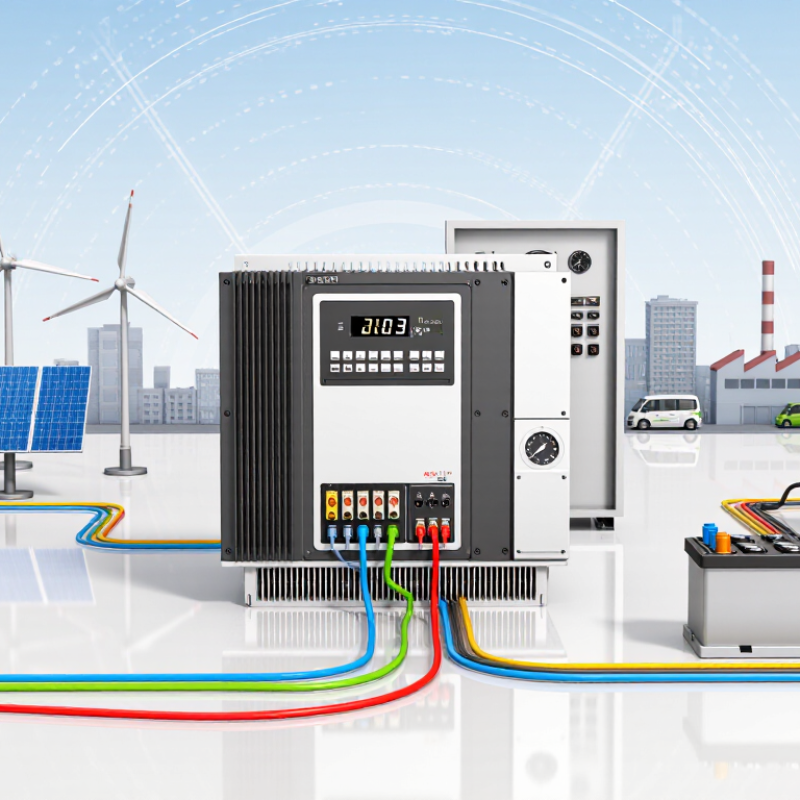
What Is a Three-Phase Power Converter and How Does It Work?
A three-phase power converter changes electrical energy from one form to another. It may convert AC to DC, DC to AC, or alter voltage and frequency. Three-phase systems use three alternating waveforms, spaced 120 degrees apart. This arrangement delivers smoother power than single-phase equipment.
Inside the converter, switches rapidly control current flow through power semiconductor devices. A rectifier may create DC from incoming AC. A DC link then stabilizes that energy with capacitors and filters. An inverter produces a controlled AC output by switching the DC voltage in timed patterns. Sensors monitor current, temperature, and voltage. The control system adjusts switching speed when the load changes.
Choose a converter by checking input voltage, output voltage, frequency, and continuous power. Measure the load.
Motor starting can demand several times its running current. A converter sized only for normal operation may trip unexpectedly. Leave practical headroom, often 20 to 30 percent, after confirming the manufacturer’s data and local electrical requirements. Efficiency matters, but cooling matters more in a dusty cabinet or a hot room. Check enclosure protection, overload behavior, harmonic limits, and communication features. A neat specification can mislead. Installation quality, cable length, grounding, and ventilation may decide real performance. I would also verify service access and replacement parts before purchase, because a technically perfect unit can become inconvenient to maintain. Testing under the actual load is wiser than trusting an unloaded bench test.
| Converter Type | Basic Operating Principle | Typical Input | Typical Output | Typical Efficiency | Frequency Control | Motor Starting Capability | Best-Fit Applications | Key Selection Consideration |
|---|---|---|---|---|---|---|---|---|
| Variable-Frequency Drive (VFD) | Converts AC to DC through a rectifier, smooths the DC link, then electronically synthesizes variable-frequency three-phase AC through an inverter. | Single-phase or three-phase AC, commonly 200–240 V, 380–415 V, or 440–480 V at 50 or 60 Hz. | Three-phase AC with adjustable voltage and frequency; commonly 0–400 Hz, depending on the model and motor. | Approximately 95–98% | Yes; precise speed control and programmable acceleration and deceleration. | Excellent when correctly sized; current limits and ramp settings reduce inrush stress. | Pumps, fans, conveyors, compressors, machine tools, mixers, and variable-speed motor systems. | Check motor current, overload rating, enclosure, braking requirements, harmonic limits, and motor insulation compatibility. |
| Rotary Phase Converter | Uses a rotating idler motor to generate a third phase from a single-phase supply and balance the three-phase output. | Single-phase AC, commonly 200–240 V or 440–480 V at 50 or 60 Hz. | Fixed-frequency three-phase AC at the supply voltage; output quality depends on balancing and load conditions. | Approximately 90–95% | No; output frequency follows the utility supply frequency. | Good for multiple motors when the converter is properly sized and balanced. | Workshops, agricultural equipment, compressors, saws, lathes, mills, and legacy three-phase machinery. | Size for the largest motor starting load and the combined running load; verify phase-to-phase voltage balance. |
| Static Phase Converter | Uses capacitors and switching components to create a starting phase shift for a three-phase motor; it does not continuously provide a fully balanced third phase. | Single-phase AC, commonly 200–240 V or 440–480 V at 50 or 60 Hz. | Three-phase motor operation at fixed line frequency, generally with reduced available motor power. | System-dependent; motor output is commonly derated by about 33–50%. | No; output frequency follows the utility supply frequency. | Limited; generally suitable for one moderate-size motor with a light or unloaded start. | Simple, lightly loaded machines where reduced motor capacity is acceptable. | Confirm the required motor derating, starting torque, capacitor settings, and suitability for the specific motor load. |
| AC-DC-AC Power Converter | Rectifies incoming AC to a DC link and then uses an inverter stage to create controlled three-phase AC output. | Single-phase or three-phase AC, selected according to the converter design and rated voltage. | Controlled three-phase AC with regulated voltage, frequency, and sometimes output waveform. | Approximately 94–98%, depending on switching frequency, load, and cooling design. | Yes; suitable for fixed-frequency conversion or variable-frequency operation. | Good to excellent when the inverter and overload rating match the load. | Industrial power conversion, test systems, frequency conversion, motor drives, and sensitive three-phase loads. | Evaluate input-output isolation, regenerative capability, harmonic performance, short-circuit rating, and control interface. |
| Three-Phase UPS with Online Double Conversion | Continuously converts AC to DC and then reconstructs regulated three-phase AC, while batteries support the DC bus during outages. | Three-phase AC, commonly 380–415 V or 440–480 V at 50 or 60 Hz. | Regulated three-phase AC with a stable voltage and frequency; battery-backed operation is available. | Approximately 90–97%, depending on load and operating mode. | Usually selectable or tightly regulated; output frequency may be independent of input frequency. | Designed primarily for electronic and critical loads; motor starting must be checked against the UPS overload rating. | Data centers, medical systems, control equipment, process automation, and other critical electrical loads. | Check battery runtime, bypass arrangement, crest-factor rating, overload duration, maintenance access, and generator compatibility. |
| Typical values are engineering ranges rather than universal ratings. Final selection must be based on the converter datasheet, nominal voltage, phase arrangement, motor full-load current, starting current, duty cycle, ambient temperature, installation altitude, enclosure requirements, and applicable electrical codes. | ||||||||
Related Posts
-
How to Choose the Right Three Phase Converter for Optimal Efficiency and Performance
-
Maximizing Efficiency with the Best Single to Three Phase Converters for Your Business Needs
-
Top 10 Benefits of Using a 3 Phase Converter for Your Business?
-
2026 Best Three Phase to Single Phase Converter Guide?
-
Best Three Phase to Single Phase Converter Solutions Today?
-

Step-by-Step Guide: How to Effectively Use a Single to Three Phase Converter in Your Projects